Updated: October 2026
Most drivers know the big rules: don't speed, don't use your phone, don't drink and drive. But the NSW Road Rules also cover plenty of small, everyday habits that many experienced drivers don't realise are offences.
Here are five completely ordinary things you might do in your car that can still earn you a fine in New South Wales — and, in some cases, demerit points.
1. Walking More Than 3 Metres Away Without Locking Your Car
Popping into the servo or grabbing a coffee and leaving the car unlocked? Under Rule 213 of the Road Rules 2014 (NSW), if you will be more than 3 metres from your vehicle and nobody is left inside, you must:
- Switch off the engine;
- Remove the key from the ignition (if no one aged 16 or over is left in the car);
- Close the windows so that no window is open by more than 2 centimetres; and
- Lock the doors.
Penalty: a fine (currently $140). No demerit points apply to this one.
There's a practical reason for it, too: an unlocked or running car is an easy target for thieves, and your insurer may refuse a claim if the car was left unsecured.
2. Driving With Your Dog (or Any Animal) in Your Lap
It might feel harmless, but Rule 297(1A) says a driver must not drive with a person or an animal in their lap. It's treated as not having proper control of the vehicle.
Penalty: a fine of more than $450 and 3 demerit points — and more of both in a school zone.
What about dog seatbelts and harnesses?
You may have heard that you'll be fined just for not using a pet restraint. That's not quite right. NSW road rules don't specifically require a harness, but you can still be fined if your pet stops you having proper control of the car or blocks your view of the road. If an unrestrained animal is injured, animal-welfare laws may also apply. A properly fitted harness, crate or carrier in the back seat is the safest option for everyone.
3. Revving Your Engine for No Good Reason
Rule 291 says you must not start or drive a vehicle in a way that makes unnecessary noise or smoke. This includes revving the engine when you're stationary, or repeatedly opening and closing the throttle while moving — the classic "showing off at the lights" move.
Penalty: a fine of more than $340 and 3 demerit points.
For learner and provisional drivers, this matters a lot: a single offence like this can use up most or all of your demerit point limit.
4. Pulling Out From the Kerb Without Indicating for 5 Seconds
This is one our instructors teach on the very first lesson — and one plenty of licensed drivers forget. Under Rules 46 and 48, when you move off from a parked or stationary position at the side of the road, you must indicate for at least 5 seconds before you pull out.
Indicating for a second or two as you move off isn't enough, and you still have to give way to all traffic before you go.
Penalty: a fine (currently $235) and 2 demerit points.
Tip: count it out — "one thousand, two thousand…" up to five — while you check your mirrors and blind spot. By the time you've done a proper head check, your 5 seconds are usually up.
5. Moving to Another Spot in the Same Timed Parking Area
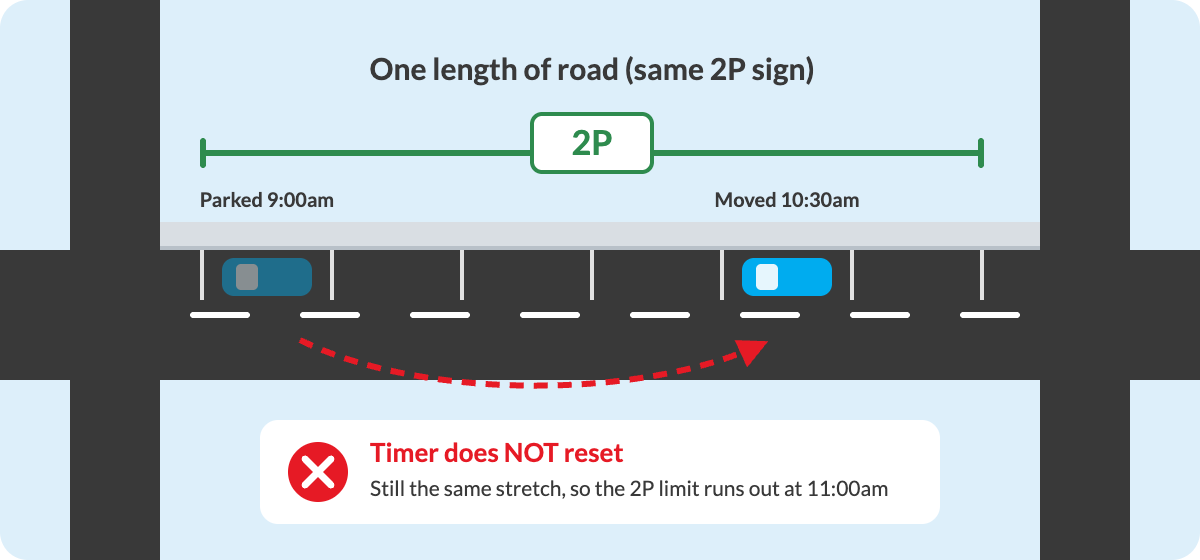
This one catches out a lot of people. You're in a 2P zone, your two hours are nearly up, so you move the car a few bays down the street. The clock resets… right?
Wrong. Under Rule 205, the time limit applies to the whole length of road (or area) covered by the parking sign, not to the individual bay. Your time keeps running from when you first parked until you move the car off that length of road or out of that area altogether.
So if you parked at 9:00am in a 2P zone and moved further along the same signed stretch at 10:30am, your limit still runs out at 11:00am.
Penalty: a parking fine, usually well over $100 depending on where you are. Ordinary time-limit offences don't carry demerit points — but nobody enjoys paying for a mistake like this.
Why These Small Rules Matter for Learner and P-Plate Drivers
A full licence holder can build up 13 demerit points before facing a suspension. Learner and P1 drivers have a much lower limit, and P2 drivers aren't far behind. That means just one "small" mistake — like the revving or animal-in-lap offences above — can cost a new driver their licence.
Double demerit points also apply to many offences during NSW long weekends and holiday periods.
Learn the Rules the Easy Way — Not the Expensive Way
Our instructors don't just teach you to pass the test — they teach the everyday habits that keep you safe, legal and fine-free for life. Book a lesson online or call us on 1300 806 506.
Official NSW Government Information
Fine amounts are indexed every year on 1 July. For the current penalties and the full rules, please refer directly to the official sources:
This information is provided as general guidance only and is not legal advice. Penalty amounts are those in effect at the time of writing and may change. Transport for NSW, NSW Police and Revenue NSW are responsible for enforcing the road rules and penalties.